

Warehouses, industrial buildings, and large-volume spaces have become a recurring design element for ventilation systems due to the significant industrial boom and the need for larger spaces for different production areas. These are enclosures with high ceilings, large surface areas, and, in many cases, significant heat loads, the generation of pollutants, dust, vapors, or the accumulation of hot air in upper areas.
Proper ventilation in these types of spaces is not only essential to ensure safe and comfortable conditions for people, but also to protect stored products, improve operational efficiency, and comply with technical and industrial safety regulations.
In this context, industrial axial fans, and in particular the Casals HJB fan, are positioned as a highly efficient, flexible, and robust solution for applications in warehouses and large-volume spaces.
These types of spaces present unique conditions that directly influence the design of the ventilation system. Among the most common challenges are large floor areas, considerable heights, the presence of equipment and machinery, frequent traffic of people and industrial vehicles, as well as the generation of heat, dust, or pollutants.
These conditions often make natural ventilation insufficient, requiring the implementation of mechanical ventilation systems capable of efficiently handling large airflows.
Calculating the Room Volume
The first step in designing a ventilation system is to determine the volume of the space to be ventilated. This parameter is obtained from the room’s floor area and its average height.
In warehouses with sloping roofs or irregular configurations, it is recommended to use a representative average height or to calculate the volume by sections for cases requiring greater precision. The volume of these spaces is calculated using: V = L * W * H
Where:
V = Volume
L = Length
W = Width
H = Height of the space
The total volume of the room is a key factor, as it forms the basis for the required ventilation flow rate.
Once the volume has been determined, the necessary airflow rate to ensure adequate indoor air renewal is calculated. The most common method used in warehouses and large-volume spaces is based on air changes per hour (AC/H).
AC/H represents how many times the total volume of the space is replaced by fresh air in one hour. The number of AC/H depends on the use of the space, the occupancy level, the presence of contaminants, and the thermal conditions. To accurately define the number of AC/H in warehouses and large-volume spaces, it is advisable to consult the technical regulations and international standards that have established criteria and guidelines based on the space’s use. Among the most recognized references are DIN 1946, as well as other industry standards such as ASHRAE 62.1 or the OSHA/NIOSH guidelines for industrial environments.
These regulations outline various calculation methods, recommendations for air changes per hour, and minimum ventilation requirements for different types of spaces, facilitating safe and efficient design. In these types of large-volume spaces, the required air change rate is typically between 10 and 20 air changes per hour (ACH).
This criterion allows for easy and clear definition of the total airflow that the ventilation system must handle. The following formula is used to calculate the airflow for large-volume spaces or warehouses: Q = V * N
Where:
Q = Airflow rate (m³/h CFM)
V = Volume of the space
N = Number of air changes per hour (h⁻¹)
In large warehouses, the total airflow required is usually high, so it is advisable to distribute it using several fans rather than concentrating it in a single unit.
Distributing the airflow across multiple fans improves air circulation, optimizes equipment placement, increases system reliability, and simplifies maintenance.
HJB Fan
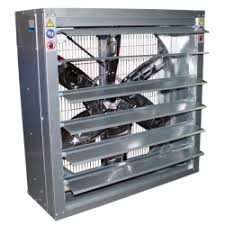
The HJB Fan has been specifically designed for industrial applications requiring high airflow, high reliability, and installation flexibility.
CLICK IMAGE FOR MORE INFO
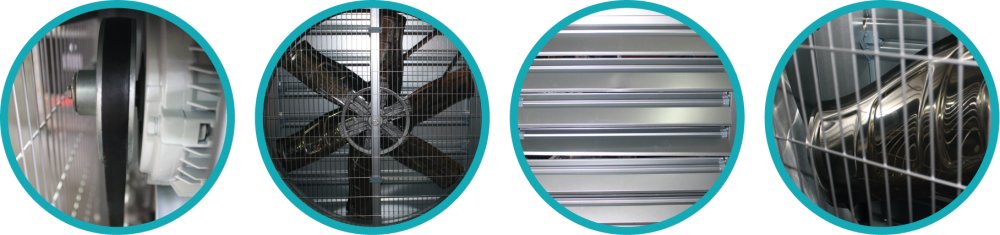
This unit is characterized by its wide range of sizes, allowing it to adapt to different airflow requirements and mounting configurations. Its design makes it ideal for installation on walls, facades, roofs, or in short duct systems.
The HJB fan, thanks to its robust construction and wide range of sizes, including the HJB 90, 110, 120, and 140, offers airflow rates from 9,000 CFM to 24,000 CFM. Its versatile installation makes it an ideal solution for these types of applications, providing high energy efficiency, the reliability that the Casals brand offers with over 100 years of market experience, and the adaptability of its design to a wide variety of industrial scenarios.
ING EMMANUEL FERNÁNDEZ VORTICE LATAM