
Handling of fatty vapors in industry
In various applications across the food service, industrial, food processing, and commercial sectors, ventilation systems must handle air currents containing fatty vapors, oil aerosols, and organic particles generated during cooking and heating processes. These contaminants have specific characteristics and properties that directly influence the design of extraction systems, as they tend to condense and adhere to the internal surfaces of ducts and ventilation equipment. As a result, progressive grease buildup occurs, affecting system efficiency, increasing pressure losses, and potentially posing a fire hazard if not properly addressed.
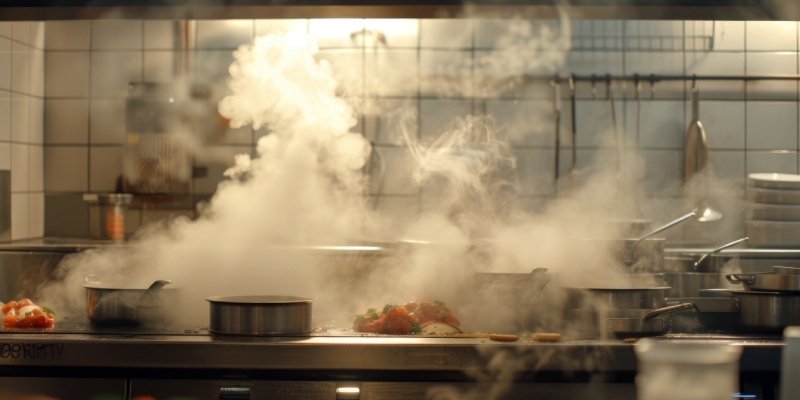
From a ventilation system design perspective, one of the main challenges associated with managing grease vapors is the physical variation of the contaminants throughout the system. In most cases, the vapors emitted by cooking equipment are in a gaseous state or as very fine aerosols; however, as the air moves through the ventilation system, its temperature decreases, forming liquid films on various internal surfaces. This process, in addition to increasing system fouling, can cause mechanical imbalances in the fans due to the uneven deposition of these films on the equipment’s blades and impellers.
For this reason, the design of ventilation systems for these types of applications must consider specific criteria aimed at reducing the accumulation of contaminants within the system and facilitating their drainage. Among the most relevant aspects to consider when designing such a system is the construction of the equipment. This is because backward-curved blades have a lower tendency to retain particles compared to other design configurations. Likewise, it is advisable to use fans whose design facilitates condensate drainage and grease removal, in order to prevent the accumulation of liquids inside the system, maintain the fan’s dynamic equilibrium, and preserve its lifespan.
Another important criterion in these types of applications is the fan’s location within the extraction system. In systems designed to evacuate grease vapors, it is common to see equipment installed on ceilings, roofs, or rooftops with a vertical discharge, as this allows the vapors to be expelled directly into the environment, preventing them from settling back on surfaces or entering other air intakes. Furthermore, this configuration facilitates integrated drainage in this type of equipment.
Additionally, the air currents generated by cooking processes typically have high temperatures and continuous operating conditions, requiring that the fans used have construction characteristics designed for continuous operation at high temperatures. This includes suitable bearings, a robust transmission system, and materials resistant to corrosion caused by the organic particles present in the vapors.
Among these technical solutions, up-blast fans stand out, specifically designed for grease vapor applications. In this context, the Casals Stellar Blast series is a particularly suitable alternative for ventilation systems in industrial kitchens, restaurants, and processing plants. These units are designed for installation on roofs, rooftops, or decks and feature a vertical discharge configuration that facilitates the expulsion of these vapors. They also include a grease collection system.
These units incorporate backward-curved centrifugal turbines with self-cleaning features, which helps reduce grease buildup and maintain the fan’s dynamic balance. In addition, the unit includes a condensate and grease drainage system, preventing their accumulation in the equipment and the system. These features, along with their robust construction and corrosion-resistant materials, ensure reliable performance in handling grease vapors.
Together, the correct equipment selection, proper ductwork design, and the incorporation of drainage and maintenance elements are fundamental factors in guaranteeing the safe and efficient handling of grease vapors. Using equipment specifically designed for this type of application reduces problems associated with handling this air and extends the installation’s lifespan.
ENGINEER EMMANUEL FERNÁNDEZ TECHNICAL DEPARTMENT VORTEX LATAM