
HVLS: Ventilation Fundamentals and Criteria
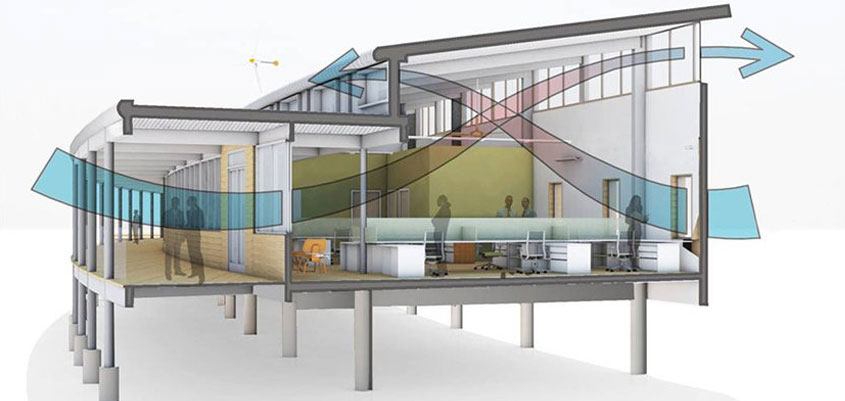
When designing ventilation systems for large spaces, such as warehouses, logistics centers, gyms, or industrial facilities, it is common to evaluate different strategies to ensure adequate thermal comfort and air quality. Among the most widely used solutions are traditional mechanical ventilation systems, based on air extraction and injection, and HVLS (High Volume, Low Speed) fans, which focus more on the mass movement of air within the space.
While both solutions fulfill functions related to environmental conditioning, their operating principles, scope, and technical objectives are fundamentally different, so their correct application depends on the type of problem to be solved.
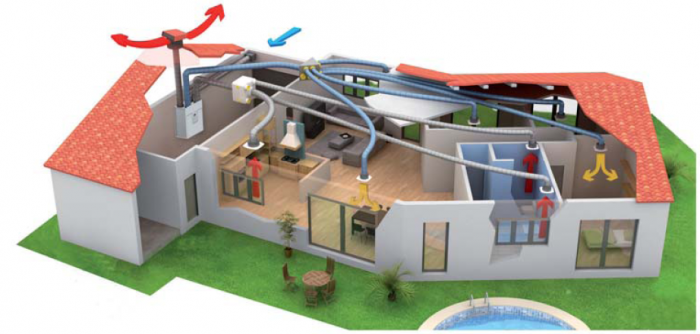
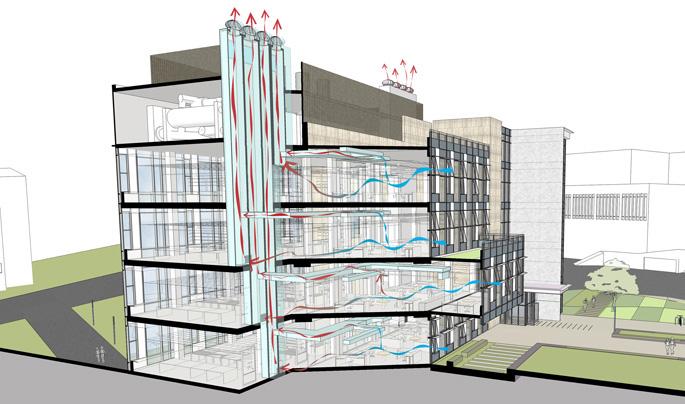
Traditional mechanical ventilation is based on the principle of air renewal, that is, the extraction of contaminated air and its replacement with fresh air from outside. This type of system is essential when it is necessary to control concentrations of contaminants, humidity, temperature, or comply with indoor air quality regulations. Their design is based on parameters such as air changes per hour (ACH), extraction and supply flow rates, and pressure control within the space.
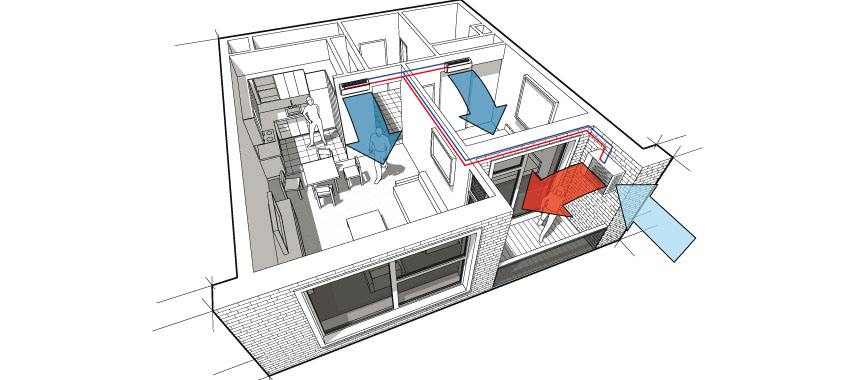
On the other hand, HVLS fans are not designed to renew the air, but rather to move large volumes of air within the same space, generating continuous and homogeneous circulation. Their main objective is to improve thermal distribution and increase the feeling of comfort through air movement, without the need to introduce outside air. For this reason, both solutions are not mutually exclusive, but rather complementary in many cases.
In high-ceilinged spaces, one of the main problems is thermal stratification, where warm air accumulates at higher levels while cooler air remains in the occupied zone. In systems based solely on mechanical ventilation, this phenomenon can persist even when the required air changes are met, due to the air distribution within the space, which is not necessarily uniform in most cases.
HVLS fans address this problem by generating a large-diameter downward column of air, which creates a radial dispersion promoting air mixing and reducing stratification within the space. This effect homogenizes the room temperature, reducing temperature differences and improving the efficiency of existing ventilation and air conditioning systems.
From an energy perspective, mechanical ventilation systems involve consumption associated with air movement through ducts, pressure losses, and, in many cases, the thermal conditioning of outside air. These systems are highly effective at controlling specific environmental conditions but can represent high energy consumption in large-volume spaces.
In contrast, HVLS fans allow for the coverage of large areas with a reduced number of units, thanks to their ability to generate large-scale airflow at low revolutions per minute (RPM). This translates into lower energy consumption compared to other types of mechanical elements, especially when their primary function is to improve thermal comfort without altering the air temperature.
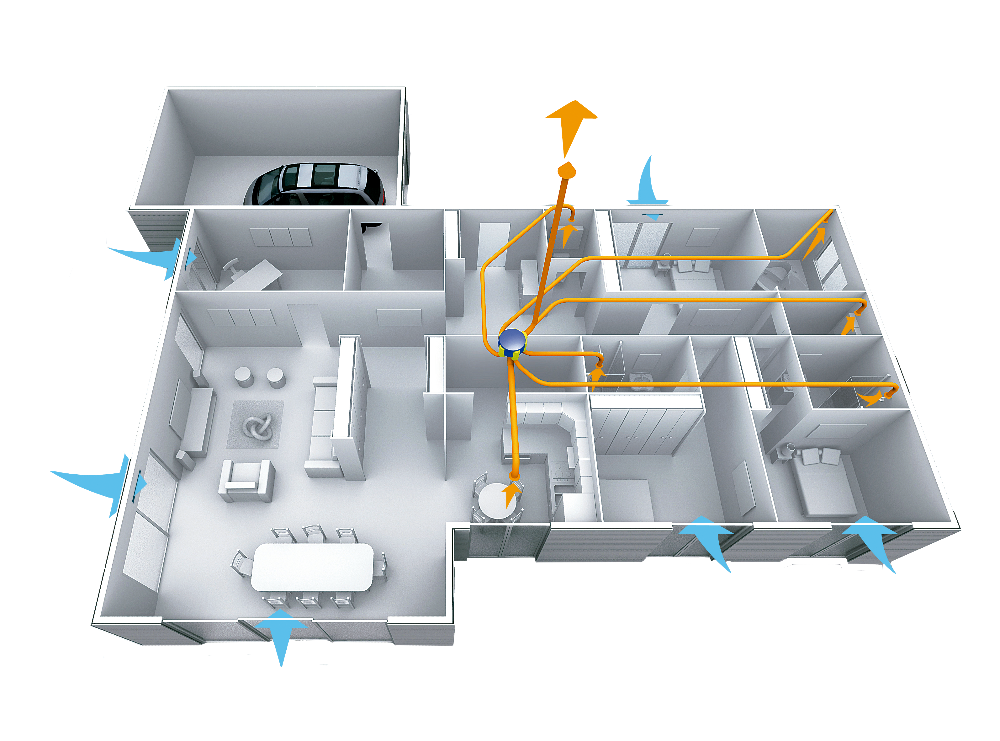
From a design perspective, the selection between mechanical ventilation and HVLS ventilators should be based on the technical objective of the system:
- When the primary requirement is contaminant control, vapor extraction, humidity control, or regulatory compliance, mechanical ventilation is essential.
- When the goal is to improve air distribution, reduce thermal stratification, or increase thermal comfort, HVLS fans can offer a better solution and greater efficiency.
- In many applications, it is common to use both systems in an integrated manner, where mechanical ventilation handles air renewal and quality, while HVLS fans improve air distribution within the space.
- Within this context, HVLS fans have evolved toward more efficient solutions. An example of this is the Hyper Blade series, an evolution of the Super Blade line.
- These units have been designed for large-volume applications, featuring improved blade aerodynamics, high-efficiency, maintenance-free motors, and sizes that allow for the movement of large airflows as needed with low energy consumption. Their design promotes the generation of a stable and uniform airflow, making them a suitable solution to complement mechanical ventilation systems in industrial, commercial, and sports facilities.
- Traditional mechanical ventilation and HVLS fans are not equivalent solutions that can be substituted for one another; rather, their selection must be linked to the specific requirements of the system. While mechanical ventilation ensures air renewal and quality, HVLS fans optimize air distribution and improve thermal comfort.
In large-volume applications, combining both technologies allows for more efficient and balanced systems, reducing energy consumption and improving the overall performance of the installation.
ENGINEER EMMANUEL FERNÁNDEZ